
Get a baseline before anyone orders one.
Most people don’t get a bone density scan until insurance pays for it, and by then the first sign is often a fracture. Bone loss starts years earlier — often around perimenopause — and a scan in your 40s or 50s tells you where you’re starting from while there’s still time to do something about it.
- Axial skeleton DEXA — lower spine and hips, with a T-score and Z-score for each
- No referral · from $200 · printout in hand before you leave
- Book for yourself, or for both of you — two scans run back to back in one visit
- Run by a bone densitometristNicole Weber, owner, or Lucy Downs, BSN, RN
- Lower spine and hips (axial skeleton DEXA)
- T‑score and Z‑score for each site
- No referral · from $200 · HSA/FSA
- Printout in hand before you leave
- Book for both of you — back to back

Scan + MD Review
T-score and Z-score for your lumbar spine and both hips
A physician reads your scan and goes over it with you.
- Written report from Dr. Zalzala in 5–7 days
- Live virtual consult to go over it
- No referral · HSA/FSA
 Physician review, with DexaFit GreenvilleRead by Dr. Zalzala, MD
Scan, printout only
T-score and Z-score for your lumbar spine and both hips
Your own doctor reads the results.
- Printed report in hand before you leave
- Take it to your own doctor
- No referral · HSA/FSA
Same scan either way — the difference is who reads it. What the MD Review includes →
Add a full DEXA Body Scan while you're here
Body fat %, lean muscle, belly (visceral) fat and whole-body bone mass, reviewed with you on screen before you leave. The $99 price is only available when you add it to a bone density scan — on its own it's $149. After you pick your appointment time, you'll see it listed as an add-on; tick it and it's added to the same visit.
What a bone density scan measures
Bone is living tissue with a honeycomb structure inside. A DEXA scan measures how much mineral is packed into that structure at the sites that matter most if bone gets weak.

On the left, the inner honeycomb is dense and tightly packed. On the right, it has thinned out and the gaps have opened up — that is osteoporosis, and it has no symptoms. The hip and the lumbar spine are where it does the most damage, which is why the scan measures those sites directly and why doctors use these numbers to diagnose it.
You get both scores for your lumbar spine and each hip, plus the bone mineral density measurement behind them. Reading them is a physician’s role — your own doctor with the printout, or Dr. Zalzala with the MD Review.
The physician behind the MD Review


Dr. Zalzala, MD
Dr. Zalzala focuses on longevity, bone health and metabolic health, and believes maintaining bone density and muscle mass is one of the strongest predictors of long-term independence and vitality.
Through the DexaStrong program, in partnership with DexaFit Greenville, he reviews DEXA results with patients one-on-one, translating the numbers into a clear, personal plan for what to do next.
The clinician who runs your scan
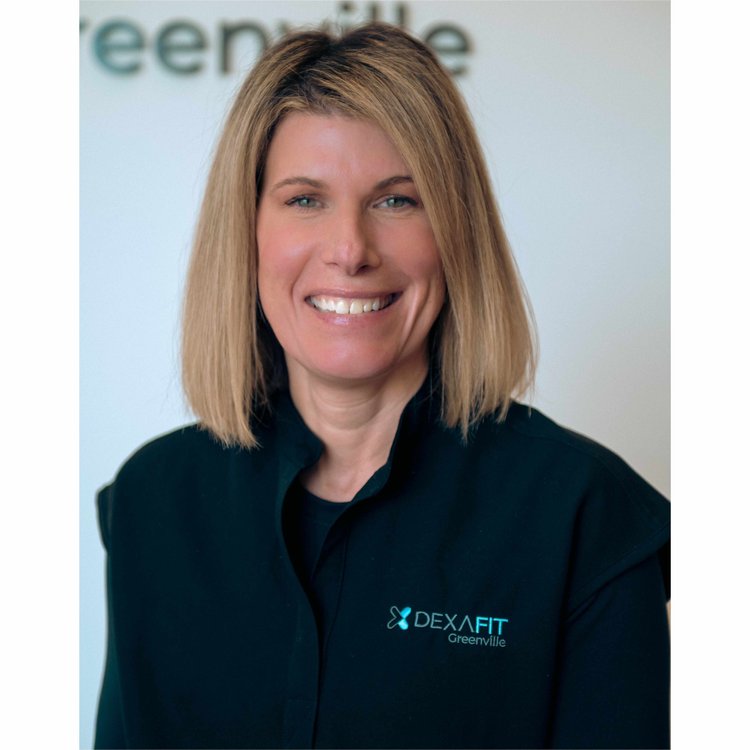
Nicole Weber
Nicole Weber is a wellness professional with more than 15 years of experience in personalized fitness and nutrition, and has dedicated her career to helping people reach sustainable health and performance goals.
As CEO of DexaFit Greenville, she combines deep expertise in body composition, metabolic health and training with a commitment to empowering clients through data-driven insights. Her leadership emphasizes education, community and long-term wellness partnerships, making DexaFit Greenville a trusted hub for proactive health in Upstate South Carolina.
What happens at your visit
Book online, walk in
Pick a time. No referral, no prescription, no insurance pre-approval. Plan on about 30 minutes for the appointment.
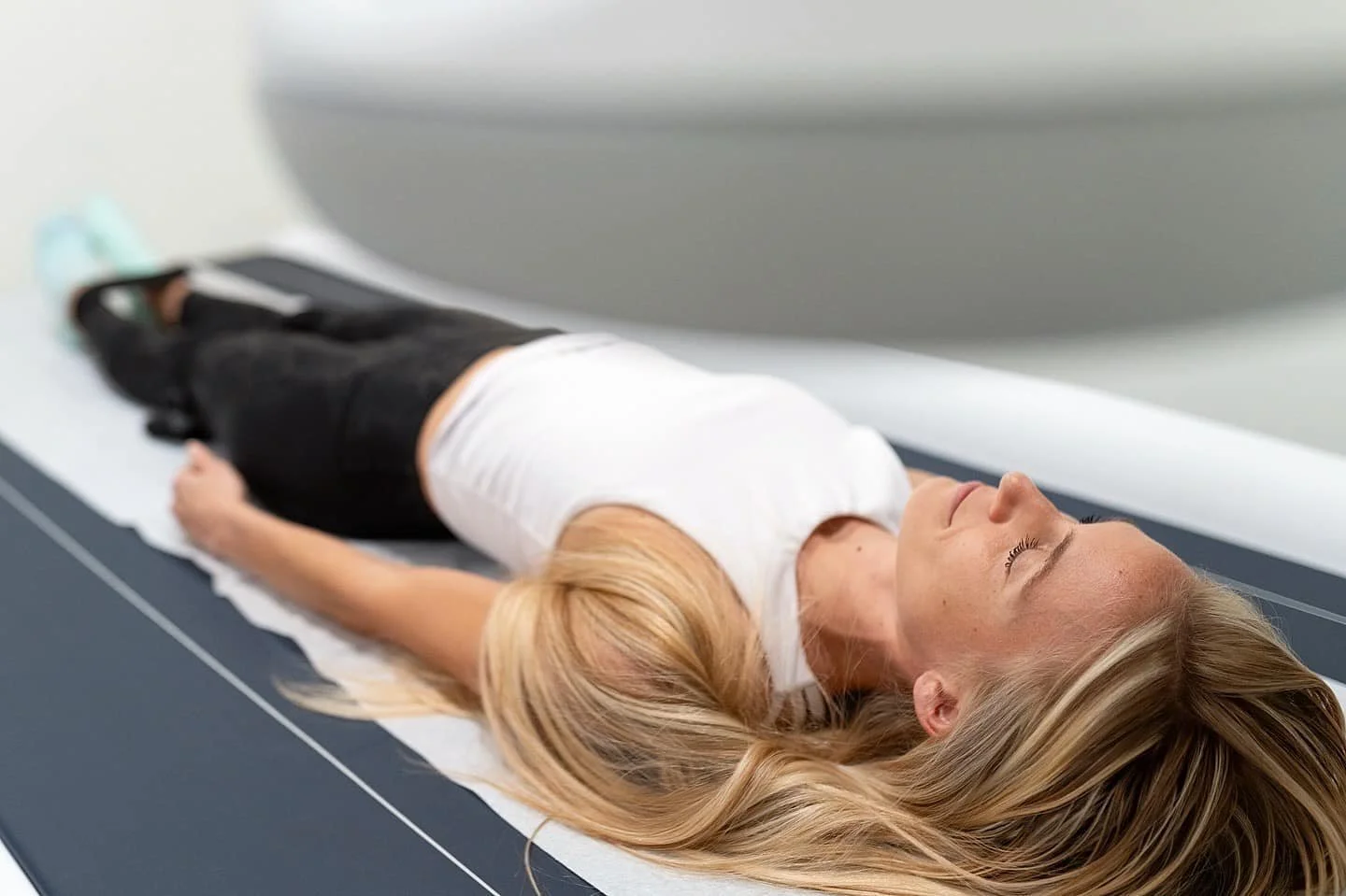
Lie still for a few minutes
You stay in your own clothes — no gown. A licensed bone densitometrist runs the scan while you lie on the table; the scanner passes over your hips and lower spine. The dose is tiny — less than you get on a flight from New York to LA.
Get your results
Printout only: you leave with the printed report — bone density with a T-score and Z-score for your lumbar spine and each hip — to take to your doctor. MD Review: Dr. Zalzala's written report reaches your inbox in 5–7 days, and your live consult with him — scheduled before you leave — follows about two weeks after the scan.
How to prepare — it’s short
Far less than a body scan needs. The one rule that matters is the calcium.
No fasting, no rest day
Eat, drink and train as usual, and take your regular medications as prescribed. Nothing about your normal day needs to change.
No calcium for 24 hours
No calcium supplements, multivitamins containing calcium, or antacids like Tums for 24 hours before your scan. Calcium is exactly what this scan measures, so a supplement in your system can skew the reading. Calcium-rich food is fine.
No metal, and shoes off
Athletic wear or leggings are ideal; avoid denim and thick fabrics like heavy sweatpants. There’s a place to change here if you’d rather. Shoes come off, so wear socks or bring a pair, and take off jewelry that comes off easily — small studs, tiny nose piercings and permanent jewelry are fine.
A few last things
Skip cologne, perfume, lotion, powder and deodorant on your torso that morning — some contain minerals that show up on the image. If you’ve had barium, contrast, or a nuclear medicine scan, wait 7 days — 14 after a barium study. Tell us about hip or spine hardware or a previous fracture at either site.
What's in the MD Review report
Every MD Review comes with a written bone densitometry report from Dr. Zalzala, sent to you before your consult. It's built so you can read it without a medical background.
Summary of findings
Your overall result in one line, then a short letter from Dr. Zalzala on what he sees and what he recommends.
Site-by-site results
Lumbar spine, right hip and left hip, each with bone mineral density, T-score, Z-score and his interpretation.
How to read it — and someone to explain it
A plain-English guide to what T- and Z-scores mean and what actually moves bone density. Then Dr. Zalzala goes over the whole report with you in your consult, so you're never left to interpret it on your own.
Body scan or bone density scan?
Both use the same DEXA machine, and they answer different questions. Many people get both in one visit.
| Bone Density Scan | DEXA Body Scan | |
|---|---|---|
| Looks at | Lower spine and hips (the axial skeleton), site by site | Your whole body, region by region |
| Measures | Bone mineral density, with a T-score and Z-score for each site | Body fat %, lean muscle, belly (visceral) fat, whole-body bone mass (context only) |
| Used for | Bone health — the scan doctors use when they assess osteoporosis and osteopenia | Body composition — tracking fat loss, muscle gain, and metabolic health |
| You get | A printed report in hand before you leave, or a physician's written report and live consult with Dr. Zalzala | Results reviewed with you on screen, in the app, and by email |
| Price | $200 printout only $349 with MD Review | $149 on its own $99 when you add it to a bone density scan |
Questions people ask before booking
Yes. An axial skeleton DEXA measures the bone mineral density of your lower spine (the lumbar vertebrae) and your hips — exactly the scan we do. Your results come back with a T-score and a Z-score for each site — the numbers your doctor uses to check for osteopenia and osteoporosis.
Orders word it several ways, and they all mean this scan: axial skeleton DEXA, central DXA, DXA of the hip and spine, bone density scan, or procedure code 77080. Book either option below. You don’t need to bring the order, but bring a copy if you have one so we can see which sites your doctor asked for.
No. You book directly with us — no referral, no prescription, no insurance pre-approval. If your doctor has asked you to get a bone density scan, you can book here and bring them the report.
Booking is online only — use either Book button on this page and it takes about a minute. Call or text 864-990-4425 if you’re not sure which option to choose, if you’re running late, or if the booking page gives you trouble, and we’ll point you in the right direction.
No. The bone densitometrist who runs your scan can’t interpret it, and with the printout-only option no radiologist or physician reviews the report — you take it to your own doctor to evaluate. If you’d rather have a physician read the scan, send you a written report and go over it with you, book the Scan + MD Review ($349) instead.
Both a T-score and a Z-score for each site scanned — the lumbar spine and both hips — plus the bone mineral density measurement behind them and an image of each region. The T-score compares you with a healthy young adult and is the number physicians use to diagnose osteopenia and osteoporosis; the Z-score compares you with people your own age and sex. Interpreting it, and deciding what to do about it, is a physician's role — your own doctor with the printout, or Dr. Zalzala with the MD Review.
Insurance typically doesn’t cover a bone density scan until 65 for women and 70 for men — which is why most people never get one until then. We think that’s late. Bone loss starts years earlier, often around perimenopause, and the first sign of osteoporosis is usually the fracture. A baseline in your 40s or 50s tells you where you’re starting from while there’s still time to do something about it — and for some people even that is late. We see low bone density in female endurance athletes in their late 20s, where years of hard training, low body weight and under-fueling have quietly cost them bone.
You have more reason to come in early if you’re petite or small-framed, a runner or endurance athlete with a history of stress fractures, have a family history of osteoporosis or hip fracture, have broken a bone from a minor fall, went through early menopause, take steroids or thyroid medication, or have ever had an eating disorder. No referral is needed, and you don’t have to wait for a doctor’s order. Whether and when is still your doctor’s call — we do the scan and give you the numbers.
Bone density scans are available from age 16 (a parent or guardian must be present for anyone under 18). Anyone under 20 gets a Z-score, compared with people their own age, rather than a T-score — that’s the clinical standard, not a limitation of the scan. More on that here.
Same machine, different scan — and the difference matters if a doctor is involved. The DEXA Body Scan looks at your whole body and reports fat, muscle and a whole-body bone figure; the app labels it “Bone Mass” and notes that the whole-body T-score and Z-score are for context only, not diagnosis. A doctor’s office will not accept it in place of a bone density test.
The Bone Density Scan is a targeted, higher-resolution axial skeleton scan of the lower spine and hips that produces the site-specific T-scores and Z-scores physicians use to diagnose osteopenia and osteoporosis. That is the report to bring to your appointment. If you want both, add the Body Scan for $99 when you book either bone density option.
It's the DexaStrong program, and it has two parts. First, Dr. Zalzala, a board-certified family medicine physician, reads your scan and writes a full bone densitometry report — a summary of findings, T- and Z-scores for your lumbar spine and both hips with his interpretation of each, and a plain-English guide to reading the numbers — emailed to you within 5–7 days. Then you meet him in a live virtual consult to go over it and talk through next steps. We schedule the consult while you're here for your scan, about two weeks out, so you've had time with the report before you talk. It's provided in partnership with DexaFit Greenville, and the $349 covers the scan, the report and the consult.
DEXA uses a very low dose. A hip-and-spine scan is less radiation than a cross-country flight from New York to Los Angeles — about the same as a day of ordinary background radiation. You stay in your own clothes — no gown — and we only ask that there’s no metal in the scan area. See how to prepare for the full list. Let us know if there’s any chance you’re pregnant; we can’t scan you if there is.
HSA and FSA cards are accepted at booking. We don't bill insurance — which is how we keep the price well below most hospital and imaging-center rates. You pay us directly, and we'll give you an itemized receipt if you want to submit it yourself; whether your plan reimburses is up to your insurer.
Printout only: you leave with the printed report in hand. MD Review: Dr. Zalzala's full written report is emailed to you within 5–7 days, and you go over it with him in your live virtual consult about two weeks after the scan. If you add the DEXA Body Scan, those results are reviewed with you on screen and sent to your email and the DexaFit app.
Book your bone density scan
Online, no referral, HSA/FSA eligible. Printed report in hand, or a physician's written report and consult.Online booking · No referral · HSA/FSA eligible