
On a GLP-1?
See what's happening inside.
A DEXA Body Scan shows what's actually changing inside — fat, lean muscle, visceral fat, bone. Ten minutes on an open table. Results explained before you leave.

Across the major GLP-1 trials, the share of total weight lost that came from lean mass rather than fat. On a 40-pound loss, that's roughly 10 to 18 pounds of something other than fat.
Group averages, not predictions. Some of that lean mass is fluid and connective tissue that leaves normally with fat loss. Which is the point: the average tells you nothing about you. A scan does.
 Why people come in
Three questions we hear almost every day.
These come up so often in our results conversations that we started writing them down. All three have the same answer, and it isn't an opinion.
"How much of this is muscle?"
You're down 30 pounds and everyone's telling you how good you look. But you also notice you're weaker in the gym, or you get winded on the stairs, and you can't tell whether that's normal or whether something's going wrong. The mirror can't answer it, and neither can the number on a scale.
"What happens when I come off?"
This is the fear we hear most. People want to taper eventually, and they're genuinely afraid to. The worry is real: in the STEP 1 extension, participants regained about two-thirds of their lost weight in the year after stopping. But coming off is a plan, not a leap — and the plan starts with knowing whether your metabolism and muscle are ready.
"Why isn't my belly changing?"
The weight is coming off but the midsection isn't cooperating, and you have no idea whether that's stubborn subcutaneous fat you can pinch or visceral fat around your organs — two completely different things with completely different health consequences. Guessing has kept people stuck for months.
Visceral fat
The fat you can't pinch is the one that matters.
Subcutaneous fat sits just under your skin. You can grab it. It's mostly passive storage. Visceral fat is different. It packs into the spaces between your liver, pancreas, and intestines, and it behaves less like storage and more like an organ — releasing inflammatory signals that drain straight to your liver.
That's why two people at the same weight, same BMI, even the same body fat percentage, can have completely different metabolic health. It's also why some people with flat stomachs are carrying more risk than they realize.
Two people can carry the same weight on the outside and look nothing alike where it counts.

Illustration. Your scan reports your own visceral fat in pounds against the reference range for your sex and age — and we walk you through it on screen before you leave.
 The scan
Ten minutes on an open table.
Everything underneath.
Our GE Lunar Prodigy is a medical-grade DEXA scanner, AI-enhanced, calibrated every morning before we open. You lie fully clothed on an open-air table — no tube, no needles, nothing enclosed — while the arm passes over you. That's the whole procedure, exactly as you see it here.
- Fat, lean muscle and bone separated out, region by region
- Visceral fat reported directly, in pounds
- Total-body bone as part of the composition picture (a hip-and-spine osteoporosis scan is a separate test)
- Radiation roughly equal to a few hours outdoors
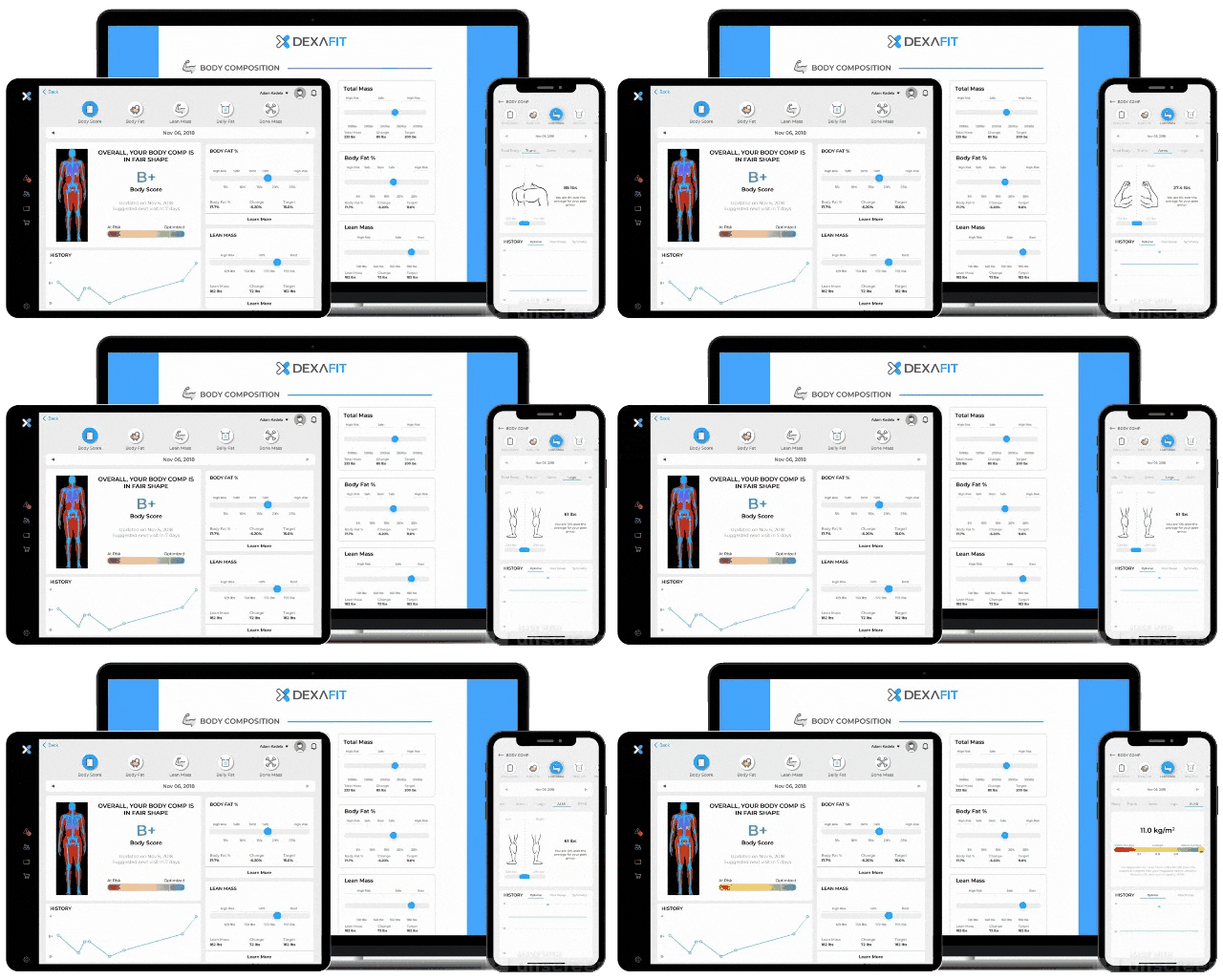
Results come up on the big screen before you leave, and land in the DexaFit AI app so you can compare scan to scan and share them with your doctor.
Book your DEXA scan
 Timing
One scan is a snapshot. Two is a direction.
A single number tells you where you stand today. The value compounds when you can see which way things are moving — and whether what you changed actually worked.
Set your baseline
Everything afterward is measured against this. If you've already started, don't wait for a perfect moment — today becomes the baseline instead. Scanning at month four is far better than never scanning at all.
Check what's actually leaving
Three to four months is long enough for real change to register and short enough to course-correct. This is where you find out whether your protein intake and resistance training are protecting your muscle — or whether they need to. Visceral fat often moves here even when total weight has stalled.
Find out if you're ready to come off
This is the scan almost nobody thinks to get, and it's arguably the most useful one. Pairing DEXA with an RMR test shows you both halves of the regain question: how much lean mass you're carrying, and what your metabolism is actually burning now versus what it should be for your size. Tapering with those two numbers in hand is a very different experience than tapering blind.
Confirm what you kept
Maintenance is its own phase, and weight alone is a poor guide to it. You can hold your weight steady while quietly trading muscle for fat. A scan tells you whether you're actually holding the composition you worked for.
Book your session
Two ways to start.
Both are done in one visit, both include a full walkthrough of your results on the big screen, and both are HSA/FSA eligible. No doctor referral needed.
DEXA + RMR Pack
Body composition and metabolism together. Fat, lean mass and visceral fat from the DEXA; your true resting calorie burn from the RMR. This is the pairing that answers the "what happens when I come off" question, because regain is a metabolic story, not just a fat one.
DEXA Body Scan
The body composition scan on its own. Fat versus lean mass, region by region, plus visceral fat. If you want one number to anchor everything and you'd rather add metabolic testing at your follow-up, start here.
Not sure which fits? Take the 60-second quiz
and we'll point you to the right one — or call 864-990-4425 and just ask.
Clients drive in from Spartanburg, Anderson, Clemson, Lake Keowee, Hendersonville and Asheville. Free parking out front, and a waiting room with a restroom if you arrive early.
Preparing for your visit
- DEXA: fast at least 2 hours beforehand. RMR: fast at least 5 hours, overnight is best.
- Water is fine right up until your test — arrive hydrated, not dehydrated.
- Morning appointments are easiest for the fast. Bring something to eat for after.
- Workout clothes without metal. No jeans. Bring socks.
- No caffeine, stimulants or alcohol in the 12 hours before an RMR.
- Taking your medication as normal is fine — no need to change your schedule.
Quick answers
Common questions.
No, and this is easily the most common thing people ask. You've lost the chance to measure the change from your true starting point, and that's genuinely a shame. But everything from here forward is still fully measurable.
Scanning today gives you a starting line for the rest of your time on the medication, for your taper, and for maintenance afterward — which is the part most people find they actually needed anyway.
Yes. The medication has no bearing on the scan. A DEXA uses an extremely low dose of X-ray — roughly comparable to a few hours of the natural background radiation you're exposed to just being outdoors. The technology has been used in hospitals and research for decades.
Because it's the number that governs what happens next. RMR is what your body burns at complete rest, and it's driven largely by how much lean mass you're carrying. Lose muscle, and that number falls.
The uncomfortable version: if you come off your medication burning meaningfully fewer calories than you did before you started, your appetite returns to a body that now needs less food than it used to. That's the mechanism behind regain, and it's measurable well before it becomes a problem.
No, and we won't pretend otherwise. We're a testing facility, not a prescriber — those decisions belong to you and your doctor.
What we give you is the data that conversation is usually missing. DexaFit reports use the same clinical terminology your physician already reads, and clients regularly bring their results to GPs, endocrinologists and dietitians. Most doctors are working from a scale reading; you'd be handing them tissue-level detail instead.
It could be either of two very different things, and they call for different responses. Stubborn subcutaneous fat is a cosmetic and patience issue. Elevated visceral fat is a metabolic one.
They look identical from the outside. A DEXA reports them separately, so instead of guessing for another six months you'd know which you're dealing with by the end of your appointment.
Rapid weight loss from any cause — medication, surgery, or aggressive dieting — is associated with reductions in bone mineral density, particularly at the hip. It isn't unique to these drugs.
It's worth knowing about if you're over 50, postmenopausal, or losing weight quickly without resistance training. The body scan reports a total-body bone figure, which is useful for watching the trend scan to scan. If you want the hip-and-spine T-scores doctors use to diagnose osteopenia, that's our separate DEXA Bone Density Scan — $200 printout only, or $349 with a physician's written report and consult. Book that, and you can add the Body Scan to the same visit for $99 instead of $149.
Most clients on GLP-1 therapy scan every 3 to 4 months while they're actively losing. That's long enough for meaningful change to show up above the noise, and short enough that you can still act on what you find.
Once weight stabilizes, every three to six months is plenty.
The DEXA scan itself runs about 10 minutes; the appointment is booked for 30. The DEXA + RMR Pack is 45 minutes.
In both cases well over half that time is spent going through your numbers with you on the big screen. No waiting on a lab, and everything lands in the DexaFit AI app so you can revisit it or share it later.
DexaFit Greenville
You're doing the hard part.
Find out if it's working.
Ten minutes on the table. One set of numbers that changes what you do next.
DexaFit Greenville provides body composition, metabolic and fitness assessments for informational and wellness purposes. Nothing on this page is medical advice, a diagnosis, or a recommendation to start, stop, or change any medication. Ozempic®, Wegovy®, Mounjaro® and Zepbound® are trademarks of their respective owners and are not affiliated with DexaFit. Always talk to your physician about your treatment.