
Stop guessing about your metabolism. Measure it.
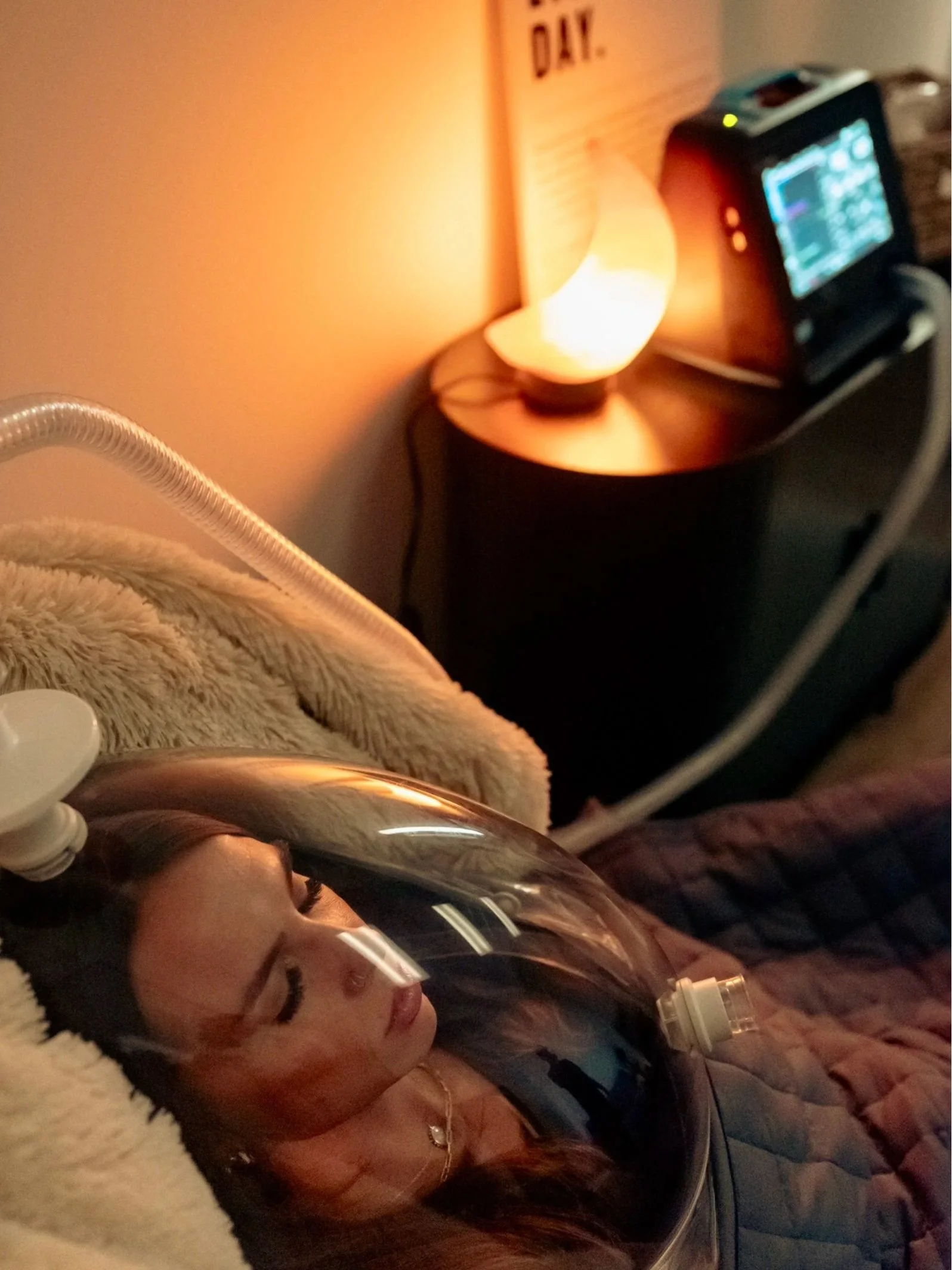
Find out exactly how many calories your body burns at rest — measured from your breath, not estimated from a formula. About 15 minutes lying back under a clear, ventilated canopy on the COSMED Q‑NRG‑Max: no mask, no mouthpiece, no nose clip. You breathe normally, we measure, and the DexaFit app turns the number into daily calorie targets. Results explained before you leave, a mile from Furman in north Greenville.
Exactly how many calories you burn at rest — measured from your breath under a clear canopy. No mask, no mouthpiece.
~15 min test · no referral · results the same visit
Book RMR Metabolism TestAdds a DEXA Body Scan for $99 more — what you burn and what you’re made of
Book DEXA + RMR PackBeen told to breathe through a tube with your nose clipped? We don’t do that →
Four things a calculator can’t tell you.
Online calculators take your age, height and weight and hand back a number. This test measures what your body actually does at rest — then compares it to people your age and sex, and tells you what to do with it.
Your true calorie baseline
The calories your body burns lying still — heart, lungs, brain, repair. Measured in kcal per day, this is the number every eating plan should be built on.
Fat or carbs at rest
From the ratio of oxygen you breathe in to carbon dioxide you breathe out, the test shows whether your body leans on fat or carbohydrate for fuel at rest — a window into metabolic health.
Slow, normal or fast — measured
Your measured burn set against what the formulas predict for your age, sex and size. Do you really have a “slow metabolism,” or is something else going on?
Calorie targets, built on your number
The DexaFit app turns your measured RMR into daily targets to lose fat, maintain or build muscle — and we show you how to use them before you leave.

The number your plan starts from. Not a guess.
Every calorie target you’ve ever been handed — by an app, a trainer’s spreadsheet, a weight-loss clinic — was built on an estimate of your resting burn. The best equation lands within 10% for most people, but misses by more than that for nearly one in five, and nearly one in three when BMI is over 30.3
Ten percent on an 1,800-calorie metabolism is 180 calories a day — more than 1,200 a week. That is the difference between a plan that works and one that quietly stalls. Measuring replaces the guess.
Measured RMR, fuel mix and how you compare to your predicted value are all in your results, in the app the same day.
No mask. No mouthpiece. No nose clip. Just breathe.
Most RMR tests clamp a mouthpiece between your teeth and pinch your nose shut for the whole measurement. Ours uses a ventilated canopy — a clear, lightweight hood that rests over your head and pillow while you lie back under a weighted blanket. Because resting metabolic rate measures your body at true rest, how relaxed you are isn’t a comfort detail. It’s the measurement.
Mouthpiece & nose clip
- Bite down on a tube and breathe through your mouth for the entire test
- Nose clipped shut — any leak and the reading is compromised
- Tense breathing pushes the number up: in one head-to-head study, the mouthpiece read about 95 calories a day higher than the canopy, with more day-to-day noise4
- Fine for an exercise test. Not restful.
Ventilated canopy hood
- A clear dome over your head and pillow — nothing touches your face
- Breathe normally through your nose or mouth, eyes closed if you like
- The collection method named in clinical best-practice guidance and used in metabolic research labs4,5
- Less reading-to-reading variability, so your next test compares cleanly to this one4
- A clean canopy for every client, and a medical-grade filter on the air leaving the hood


The short version: the more relaxed you are, the truer the number. The canopy is how we get you there — and it’s the reason the same test somewhere else can come back higher than your body actually runs.
COSMED Q‑NRG‑Max, Italian-made. A medical-grade indirect calorimeter built for measuring resting energy expenditure, developed with the ICALIC clinical-nutrition study group and validated in canopy mode in international multicenter studies — including against the Douglas bag, the laboratory reference method.6 It’s the same class of instrument hospital nutrition units use, not a handheld consumer device.
Why not just use a calculator?
Every other number you’ve seen for your metabolism was estimated. Here’s how each method stacks up against a measured, canopy RMR.
| Canopy RMR (here) | Online calculator / app | Fitness watch | Mouthpiece test | |
|---|---|---|---|---|
| How it gets the number | Measured from your breath: oxygen in, CO₂ out | Formula from age, height and weight | Heart rate plus a formula | Measured from your breath |
| Accuracy for you | Your actual number, on a device validated against the lab reference6 | Off by more than 10% for nearly 1 in 5 people3 | An estimate built on an estimate | Measured, but tends to read high4 |
| Fuel mix (fat vs carbs) | Yes | No | No | Yes |
| What it’s like | Lie back under a blanket, breathe normally | Type in three numbers | Wear it | Tube in your mouth, nose clipped, 10–20 minutes |
| Repeatable enough to track | Yes — same device, same protocol each visit | Only changes when you change your weight | Drifts with the algorithm | More day-to-day noise4 |
Comparisons describe typical published performance of each method; individual devices and operators vary.
More than a number. Targets you can act on.
Every test comes with the DexaFit report, reviewed with you before you leave and saved in the app so your next test compares against this one.
Sample results for illustration only
| Feature | DexaFit Greenville | Typical printout |
|---|---|---|
| Measured RMR in calories per day | ||
| Measured vs predicted — is your metabolism slow, normal or fast? | ||
| Fuel mix at rest (fat vs carbohydrate) | ||
| Daily calorie targets to lose, maintain or build | ||
| Reviewed with you in person, the same visit | ||
| Results in the app the same day — no portal, no waiting | ||
| App that compares every test to your last one | ||
| Targets refined by your actual lean mass when you add a DEXA |
Working with a dietitian or coach? The full COSMED report with your raw VO₂, VCO₂ and respiratory exchange ratio is yours too — ask at your visit.
How the visit actually goes.
Book online
Pick a time — mornings are easiest for the fast. No referral, no prescription, no insurance pre-approval. Plan on 30 minutes door to door.
About 15 minutes under the canopy
Lights dimmed, weighted blanket on, spa music playing. The clear canopy rests over your head and pillow while the cart measures the oxygen you breathe in and the carbon dioxide you breathe out. Your only job is to lie still and breathe.
Your results, explained
No portal, no waiting. We put your measured burn, fuel mix and calorie targets on the big screen, show you how you compare to your predicted value, and answer anything while it’s in front of you.
Three things you leave with. Every time.
Not a number and a handshake.
Your results on the big screen
We walk you through it line by line — your resting burn, whether it’s slow, normal or fast for your age and sex, what you’re burning for fuel, and what your calorie targets should be. That part of the appointment is deliberately unhurried.
Your results in the app, the same day
Open the free DexaFit app and refresh — your measured burn, fuel mix and calorie targets are there the same day as your test. One thing to get right: sign up for the app with the same email you put on your intake form, so your results land on your account.
Every retest stacks on the last one
Your measured RMR becomes daily calorie targets to lose, maintain or build, and each retest compares against this one — so you can see whether your metabolism held, dropped or climbed as your plan went on.
Want to skip the on-screen review and just get your numbers? Say the word when you arrive.
Most people add the DEXA. Here’s why.
An RMR tells you what your body burns. A DEXA Body Scan tells you what it’s made of — fat, lean muscle and bone, region by region, to about ±2%. Put the two together and the DexaFit app builds your calorie targets from your measured burn and your actual lean mass, not a formula’s guess at either. It’s the most complete picture of your metabolism we offer, and the most-booked thing we do.
Both tests run in one 45-minute visit, with one results review at the end. Nothing extra to schedule.

On a GLP-1? Your metabolism is moving. Measure it.
As weight comes off, your resting burn comes down with it — partly because there’s less of you to run, and partly because the body adapts. After large weight loss, resting metabolism can settle lower than your new weight predicts, and stay there.7 The calorie target that worked on day one quietly becomes the wrong one.
A measured RMR replaces the calculator’s guess with the number your body is actually running on now. Pair it with a DEXA and you also see whether the weight coming off is fat or muscle — the question a scale can’t answer.
Most clients on a GLP-1 test before they start or early on, then every 3–4 months while they’re actively losing.

You have your number. Now what?
A measured RMR tells you how much to eat. A dietitian tells you what. Second Arrow Nutrition shares an office inside DexaFit Greenville, which means you can pull up your results for Alex Winnicki, MS, RDN, LDN, CSSD — a board-certified sports dietitian — and turn targets into a plan: how to fuel training, how to hit protein while losing fat, how to make the next test show progress.
Start with a free 15-minute exploration call, no commitment.
How to prepare
The test measures you at rest, so anything that raises your metabolism beforehand raises the number. Three things decide whether it’s accurate.
Food & drink
- Fast at least 5 hours — no food or caloric drinks. Water is fine; overnight fasting with a morning appointment is easiest
- No caffeine or nicotine for at least 3 hours before — that includes black coffee
- No alcohol for 12–24 hours
- Hydrate normally. Don’t load up on water right before
Activity & rest
- No hard workout for 24 hours — anything above an easy, conversational pace. Walking the dog or gentle yoga is fine
- Arrive rested and relaxed. A calm nervous system gives a truer reading
- Avoid extreme heat or cold beforehand — no sauna, no cold plunge that morning
- Plan to arrive about 10 minutes early so you’re not rushing in
Worth knowing
- Wear comfortable clothes — you’ll be reclining under a blanket, fully dressed
- Lie still and don’t talk during the test. Eyes closed is fine; sleeping is not
- Pairing with a DEXA? The DEXA rules apply too — no metal in your clothing, socks on
- Retesting? Book a similar time of day under similar conditions so the comparison is real
Questions people ask before booking.
RMR stands for resting metabolic rate — the calories your body burns at rest just to keep you alive. We measure it with indirect calorimetry: as you breathe normally under the canopy, the COSMED cart measures how much oxygen you take in and how much carbon dioxide you breathe out. Those two numbers tell us how many calories you’re burning and whether the fuel is mostly fat or carbohydrate.
The measurement runs about 15 minutes. The first few minutes are discarded while your breathing settles, and the reading is taken once it’s stable — the same protocol clinical best-practice guidance recommends.5
Because the test measures you at rest, and a tube clamped in your teeth with your nose pinched shut isn’t rest. Anxiety and altered breathing push the reading up: in a head-to-head comparison, the mouthpiece and nose clip read about 95 calories a day higher than the ventilated canopy, with more day-to-day variability.4 The canopy is the method used in metabolic research labs and clinical nutrition units.
Every client gets a clean canopy, and nothing touches your face. The air leaving the hood passes through a medical-grade filter.
Calculators and watches don’t measure your metabolism; they estimate it from your age, height, weight and sometimes heart rate. The best-performing equation lands within 10% of the measured value for about four in five non-obese adults, and only about seven in ten when BMI is over 30 — so a meaningful share of people are being handed a number that’s off by hundreds of calories a day.3
The canopy test measures your actual gas exchange on a device validated against the laboratory reference method.6 It’s your number, not the average person’s.
Basal metabolic rate (BMR) is measured under strict laboratory conditions — first thing on waking, after an overnight stay, in a temperature-controlled room. Resting metabolic rate (RMR) is measured under everyday conditions after a few hours of fasting and rest, and runs slightly higher. RMR is what nutrition professionals and the DexaFit app use to set calorie targets, and it’s what we measure.
This test answers that directly. Your report shows your measured burn against the predicted value for your age, sex and size, so you can see whether you’re genuinely below average, right on it, or above. Most people are closer to normal than they expect, and a “slow metabolism” often turns out to be less lean muscle, an underestimated intake, or a calorie target that was wrong from the start. Either way, you leave knowing which.
It depends mostly on how much lean mass you carry, then on age and sex. Many adults land somewhere between roughly 1,200 and 2,000 calories a day, with larger and more muscular people above that. “Normal” for you is best read as your measured number against your own predicted value — which is exactly what the report shows.
Yes — at least 5 hours without food or caloric drinks, and no caffeine or nicotine for 3 hours. Digesting a meal and caffeine both raise your metabolic rate for hours, so the reading comes back higher than your true resting burn. If you slipped, call or text us and we’ll move you to a later slot rather than run a test you can’t trust.
It’s the foundation of it. Fat loss comes down to eating below what you burn, and most plans fail because the “what you burn” part was guessed. A measured RMR gives you the real baseline; the app turns it into a fat-loss target that’s aggressive enough to work without being so low that you lose muscle and stall. Retesting every few months shows whether your metabolism is holding as the weight comes off — especially useful on a GLP-1.
Every 3–6 months if you’re actively changing your body — losing weight, on a GLP-1, or in a hard training block — or after any change of about 10% in body weight. Otherwise once or twice a year is plenty. We test you on the same device with the same protocol every visit, so the comparison is real.
No. Book online, come in, and we go over your results with you before you leave. No prescription, no insurance pre-approval. HSA and FSA cards are accepted. We don’t bill insurance — which is how we keep the price well below most hospital rates; we’ll give you an itemized receipt if you want to submit it yourself.
We review them with you on screen before you leave, and they’re in the free DexaFit app the same day — pull down to refresh if you don’t see them yet. Sign up for the app with the same email you use on your intake form so your results attach to your account. If you add a DEXA Body Scan, that report is also emailed to you as a PDF; RMR results live in the app.
Booking is online only — use any Book button on this page and it takes about a minute. Call or text 864-990-4425 if you’re not sure which test to choose, if you’re running late, or if the booking page gives you trouble, and we’ll point you in the right direction.
Yes, and most people do. DEXA + RMR ($278, about 45 minutes) is our best seller — what your body is made of plus what it burns, with calorie targets built from both. The Works adds VO2 Max and grip strength. See pricing.
Sources & notes
- Resting metabolic rate typically accounts for about 60–75% of total daily energy expenditure in adults; the share is lower in very active people.
- Respiratory exchange ratio (VCO₂/VO₂): about 0.70 when fat is the only fuel, 1.00 when carbohydrate is; resting, fasted values generally fall in between.
- Frankenfield D, Roth-Yousey L, Compher C. J Am Diet Assoc. 2005;105(5):775–789 — the Mifflin-St Jeor equation predicted measured RMR within 10% in about 82% of non-obese and 70% of obese adults; individual errors well beyond 10% were documented. See also Frankenfield DC. Clin Nutr. 2013;32(6):976–982 (87% vs 75%).
- Roffey DM, Byrne NM, Hills AP. JPEN J Parenter Enteral Nutr. 2006;30(5):426–432 — RMR averaged about 95 kcal/day higher and within-individual variability was greater with a mouthpiece and nose clip than with a ventilated hood in the same healthy adults.
- Compher C, Frankenfield D, Keim N, Roth-Yousey L. J Am Diet Assoc. 2006;106(6):881–903 — best-practice methods for RMR measurement (fasting, rest, abstention from caffeine, nicotine and exercise; steady-state measurement). Isbell TR et al. JPEN. 1991;15(2):165–168 (ventilated canopy reliability).
- COSMED Q‑NRG: Delsoglio M et al. Clin Nutr. 2020;39(6):1927–1934 (accuracy and precision in canopy dilution mode, ICALIC); Oshima T et al. Clin Nutr. 2022;41:1591–1599 (canopy vs face-mask mode; face mask over-read REE); Q‑NRG Max accuracy and repeatability vs the Douglas bag, PLOS ONE, March 2025.
- Metabolic adaptation after large weight loss: Fothergill E et al. Obesity. 2016;24(8):1612–1619. Magnitude varies widely between individuals and with how the weight was lost.
Figures on this page describe findings in published studies of other populations and are provided for general educational context only. Sample results shown are for illustration and are not those of an actual client. DexaFit Greenville provides testing for informational and wellness purposes; results are not a diagnosis.
Stop eating for a metabolism that was never yours.
One 30-minute visit, $179, in north Greenville a mile from Furman — and you’ll know exactly what your body burns at rest, with calorie targets built on it before you walk out.